
Museum of Anatolian Civilizations
Ankara
Housed in an Ottoman bedesten, it tells Anatolia from the Palaeolithic to Rome along a single route, and holds the world's fullest Hittite and Neo-Hittite collection.
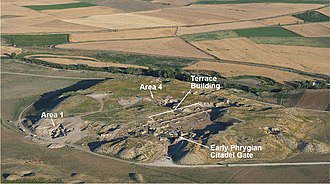
After the fall of the Hittite state, the Phrygians — most likely newcomers from the Balkans — settled central Anatolia around the Sakarya basin. Their kingdom peaked in the 8th century BCE under Midas, the "Mita of Mušku" of Assyrian sources. Cimmerian raids in the early 7th century weakened it, but Phrygian culture lived on under Lydian and Persian rule.
Ankara
Housed in an Ottoman bedesten, it tells Anatolia from the Palaeolithic to Rome along a single route, and holds the world's fullest Hittite and Neo-Hittite collection.
Ankara
Capital of Phrygia, home of the Midas tumulus and the Gordian Knot legend.

Nevşehir
An underground city descending eight levels and some 60 metres, with stables, churches, wineries and ventilation shafts enough for thousands of people.

Kütahya
Aizanoi in Çavdarhisar, Kütahya, is a Roman city famous for the best-preserved Temple of Zeus in Anatolia.

Nevşehir
Wider and lower-ceilinged than Derinkuyu, with four levels open to visitors and tunnels that still run beneath the village houses above.

Denizli
Set inside the vaulted halls of the Roman baths of Hierapolis, showing the reliefs taken from the city's theatre and sarcophagi from Lycia and Caria.

Uşak
The museum of the Lydian Hoard from the tumuli of the region, whose winged sea-horse brooch — stolen and recovered years later — has become its emblem.

Eskişehir
Cult centre of the Mother Goddess Cybele, the holiest city of the Phrygians.

Eskişehir
A Phrygian open-air sanctuary and rock-cut city in Han district, Eskişehir, famous for the 17 m-high Midas Monument.

Çorum
The central museum for the Hattusa, Alacahöyük and Şapinuwa excavations, holding the Hittite cuneiform tablets, seals and bull figurines they produced.

Balıkesir
Seat of the Persian satraps in Anatolia, a Mysian city famous for its sculpted stonework.

Afyonkarahisar
The central museum for Phrygia, weighted towards the Roman sarcophagi and sculpture cut at the marble quarries of Docimium.

Afyonkarahisar
A major Byzantine military city, remembered for its Arab sack of 838.

Denizli
A temple on the slope above the Meander gorge, whose hundreds of confession inscriptions are the frankest record of popular religion in the Roman countryside.

Yozgat
A mound near Yozgat, thought in the Iron Age to belong to the land of Tabal.