UNESCO
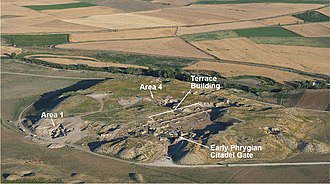
Gordion
Ankara
Capital of Phrygia, home of the Midas tumulus and the Gordian Knot legend.
Phrygian tumuli, Neolithic mounds and steppe cities.
Ankara
Capital of Phrygia, home of the Midas tumulus and the Gordian Knot legend.

Konya
One of the world's earliest urban settlements — a town without streets.

Kayseri
The Assyrian trading colony that produced Anatolia's first written documents.

Niğde
A Roman city at the gate of Cappadocia, with aqueducts and a sacred pool.

Eskişehir
Cult centre of the Mother Goddess Cybele, the holiest city of the Phrygians.

Afyonkarahisar
A major Byzantine military city, remembered for its Arab sack of 838.

Yozgat
A mound near Yozgat, thought in the Iron Age to belong to the land of Tabal.

Adana
A temple city of the Mother Goddess Ma, linked to the Hittite city of Kummanni.

Aksaray
A pre-pottery Neolithic mound near Aksaray that has yielded the world's earliest domesticated sheep and moulded mudbrick architecture.

Aksaray
A mound near Aksaray that was one of the richest centres of the Assyrian Trade Colonies period, renowned for its palaces and ivory artefacts.

Çorum
A Hittite religious and administrative city at Ortaköy, Çorum, that has produced thousands of cuneiform tablets.

Eskişehir
A Phrygian open-air sanctuary and rock-cut city in Han district, Eskişehir, famous for the 17 m-high Midas Monument.

Konya
A Neo-Hittite relief cut into the rock above a spring: King Warpalawas stands before Tarhunzas, the storm god, holding ears of grain and a bunch of grapes.

Konya
A Hittite sacred pool built over a spring and faced with gods and goddesses: one of the few monumental water structures the Hittites left standing.

Nevşehir
A cluster of monasteries and churches cut into the tuff; the frescoes of the Dark Church are among the best-preserved Byzantine paintings anywhere.

Nevşehir
An underground city descending eight levels and some 60 metres, with stables, churches, wineries and ventilation shafts enough for thousands of people.

Nevşehir
Wider and lower-ceilinged than Derinkuyu, with four levels open to visitors and tunnels that still run beneath the village houses above.

Nevşehir
A rock settlement spread over three valleys, lived in without a break until 1952, when the danger of collapse emptied it.

Aksaray
A canyon cut 100 metres deep by the Melendiz river, its walls honeycombed with frescoed rock churches.

Sivas
A paired mosque and hospital whose carved portals have no equal in Anatolia — among the first sites in Türkiye inscribed by UNESCO.

Konya
Forty-two cedar columns carry a wooden ceiling still in place after seven centuries, and the snow well at its centre is left open so winter snow can keep the timber from drying out.

Aksaray
The largest Seljuk caravanserai in Anatolia, where caravans on the Konya–Aksaray road were housed, fed and their animals shod for three days at no charge.

Nevşehir
Built from Cappadocia's yellow stone, one of the last Seljuk hans on this branch of the Silk Road, its two-tone portal set against a deliberately plain courtyard.

Kayseri
A twelve-sided tomb built for Şah Cihan Hatun, its conical cap and bands of tree-of-life, double-headed eagle and lion reliefs the emblem of Seljuk funerary architecture.

Ankara
The mausoleum of Mustafa Kemal Atatürk. Its Lion Road climbing to the ceremonial court draws Hittite and Seljuk forms into a deliberately plain language of stone.

Eskişehir
The Ottoman quarter on the slope where Eskişehir began: timber houses corbelled out over narrow lanes, with the city's meerschaum carvers still working in them.

Kayseri
The quiet valley of Cappadocia: dozens of churches cut into its slopes, their frescoes standing — unlike Göreme's — mostly without a crowd in front of them.

Ankara
Housed in an Ottoman bedesten, it tells Anatolia from the Palaeolithic to Rome along a single route, and holds the world's fullest Hittite and Neo-Hittite collection.

Konya
The tomb of Mevlâna Celâleddin Rumi and the Mevlevi lodge around it, its green-tiled dome the emblem of Konya.

Konya
The dome of a Seljuk madrasa tiled in blue and black as a night sky, with the figured tiles taken from the Kubadabad palace displayed beneath it.

Kayseri
Holding the finds of the Kültepe-Kanesh excavation, including the cuneiform tablets and clay envelopes of the Assyrian merchants.

Aksaray
A collection running from the Neolithic levels of Aşıklı Höyük to the Byzantine burials of the Ihlara valley, and one of Anatolia's lesser known sets of mummies.

Aksaray
A Seljuk han on the Aksaray–Nevşehir road, its kiosk mosque at the centre of the court making it a smaller, plainer sibling of the Sultan Han.

Konya
The palace town Alâeddin Keykubad I raised on the shore of Lake Beyşehir; the figured tiles that lined its walls are now in the Karatay Museum in Konya.

Ankara
The citadel wrapping the hill the city grew on, its walls built course by course from column drums and inscribed blocks stripped out of Roman buildings.

Ankara
The bow-fronted, whitewashed houses of a town on the Ankara branch of the Silk Road — one of the few Anatolian towns restored and kept whole rather than house by house.

Konya
The congregational mosque of the Anatolian Seljuk capital: a flat-roofed hall on forty-two reused columns, with the tombs of eight sultans beside it.

Nevşehir
The underground city north of Avanos, with a defensive arrangement unique in Cappadocia: pipes cut between the storeys so that hot oil could be poured on attackers.

Nevşehir
The rock settlement near Gülşehir is made up of dwellings and stables rather than churches — the clearest picture in Cappadocia of how a provincial Byzantine landowner lived.

Konya
A seven-metre unfinished Hittite statue still lying in its quarry, showing the storm god standing on the shoulders of a mountain god.
Karaman
A settlement cut five storeys into a valley wall, its stairs running inside the rock and its top floor reachable only from within.
Nevşehir
An underground city with four separate entrances — stables, ovens and church spaces — and one of the uncrowded ones in Cappadocia.

Niğde
The frescoes in this rock-cut monastery's church are among the best preserved in Cappadocia, and include the rare Byzantine image in which the Virgin is shown smiling.

Eskişehir
Sixty-seven wooden columns carry the roof, more than in any other Anatolian hypostyle mosque, and some of their capitals were reused from ancient buildings.

Ankara
A wooden hypostyle mosque below Ankara castle, its stucco mihrab among the most elaborate pieces of Seljuk plasterwork.

Sivas
Named for the turquoise tiles sheathing its minarets, its portal carrying vegetal carving and a zodiac of twelve animals found nowhere else.

Sivas
The hospital and medical school built for Kaykaus I, his tiled tomb set in the south iwan of the courtyard, where music and running water were part of the treatment.

Konya
Its portal, where the inscription is knotted across the stone like ribbon, is the boldest piece of Seljuk carving; the building is now a museum of stone and wood.

Kayseri
The first building to set a hospital and a medical school side by side: patients were treated while students took their lessons across the same courtyard.

Kayseri
The largest Seljuk han on the Kayseri–Sivas road, and with its namesake at Aksaray one of only two built at imperial scale.

Kayseri
Built for the emir Celâleddin Karatay, its portal carrying human-headed figures and animal reliefs in the richest sequence of Seljuk carving.

Niğde
An octagonal tomb built for a daughter of the Seljuk sultan Kilij Arslan IV, its angels, double-headed eagles and human faces carved in a combination found nowhere else in Anatolia.